Mediterranean Cruises Explained: How to Choose the Right Luxury Cruise for You
Choosing a luxury Mediterranean cruise can be surprisingly difficult. Silversea, Seabourn, Regent Seven Seas, Explora Journeys, SeaDream Yacht Club, and The Ritz-Carlton Yacht Collection can all take you from one beautiful Mediterranean port to another in considerable comfort. Look only at the marketing language, and the differences can begin to blur.
In practice, these are distinctly different ways to travel. One traveler may want a small yacht slipping into ports that larger ships cannot easily reach. Another wants a spacious suite, multiple restaurants, and enough happening on board that returning to the ship feels like returning to a resort. Someone else wants excursions and most onboard expenses incorporated into the fare so that there are few decisions left to make once the trip begins.
None of those travelers is necessarily choosing a better cruise. They are choosing a better fit.
That is the most useful way to compare luxury Mediterranean cruises. Instead of ranking cruise lines from first to sixth, start by deciding how you want your days to feel.
First, Decide What Kind of Mediterranean Cruise You Actually Want
The Mediterranean is particularly well suited to cruising. Within a relatively short voyage, you might combine the French Riviera, the Italian coast, Sicily, Croatia, Montenegro, and the Greek islands without repeatedly packing, changing hotels, and arranging transportation between them. But the ship is more than transportation. Its size, atmosphere, schedule, and approach to time ashore can fundamentally change the trip.
Do You Want a Cruise Ship or Something Closer to a Yacht?
This is one of the most important distinctions.
A small yacht can access harbors and anchorages that larger vessels cannot. SeaDream, for example, builds Mediterranean itineraries around its small scale, with calls at places such as Ponza, Bonifacio, Hvar, Cassis, and other ports that reinforce the feeling of traveling along the coast rather than simply moving between major cruise terminals.
That intimacy comes with a tradeoff. A small yacht cannot offer the breadth of restaurants, entertainment, wellness facilities, or public spaces available on a larger luxury ship.
For some travelers, that is precisely the appeal. For others, it is an unnecessary compromise.

How Important Is the Ship Itself?
Mediterranean itineraries can be intensive. On a seven-night voyage, you may wake up somewhere new almost every morning. If you plan to spend ten hours ashore each day, an enormous selection of onboard facilities may matter less. Other travelers want the ship to be an important part of the vacation.
Explora Journeys is a useful example. Its ships have been conceived around spacious accommodations with private terraces, numerous restaurants and lounges, extensive outdoor space, multiple pools, and substantial wellness facilities. The result can feel closer to a contemporary luxury resort that happens to move overnight.
Neither approach is inherently superior. The question is how much of your vacation you expect to spend enjoying the ship.
How Much Structure Do You Want Ashore?
Some travelers want to wake up knowing that an excursion is already available and much of the day's planning has been handled. Others would rather leave the ship with a private guide, have lunch independently, or spend six unstructured hours wandering a favorite town.
This distinction can materially affect the value of a cruise fare.
Regent Seven Seas, for example, includes a broad program of unlimited shore excursions as part of its standard inclusions. For a traveler who intends to use those excursions regularly, that can simplify both planning and budgeting.
For someone who expects Vantage Voyages to arrange private touring in most ports, the equation changes. An included group excursion has little practical value if you do not want to take it.
This is why comparing luxury cruises purely on price is rarely useful. You have to compare the parts of the fare you will actually use.
Six Luxury Mediterranean Cruise Styles, Explained
The following profiles are not rankings. They are a way to understand the character of six cruise lines we consider when matching travelers with a Mediterranean voyage.

Silversea: For the Destination-Focused Traditionalist
Silversea occupies a useful middle ground in luxury cruising. Its ships are small enough to emphasize destination access while still providing the amenities and infrastructure of a sophisticated luxury cruise ship.
Service is central to the experience. Silversea provides butler service in every suite category, and its onboard fare includes dining, premium beverages, gratuities, and Wi-Fi. On its Classic voyages, however, travelers should pay close attention to the fare selected: shore-excursion inclusions can differ by fare, so it is no longer accurate to assume that every Silversea fare includes the same touring ashore.
The Mediterranean is also a natural setting for Silversea's S.A.L.T. program, which connects food and destination through regionally inspired menus, culinary experiences, and, on applicable ships, hands-on cooking and food-focused programming.
Best suited to: Travelers who appreciate polished, established luxury-cruise service and want the destination to remain central to the experience. It can also work particularly well for travelers who value culinary context rather than treating dining aboard and exploration ashore as entirely separate parts of the trip.
Think twice if: Your ideal vacation is deliberately casual and yacht-like, or you want the ship to feel like a contemporary beach resort rather than a traditional luxury vessel.

Seabourn: For Relaxed, Yacht-Like Luxury
Seabourn combines the infrastructure of a luxury cruise line with an intentionally intimate, club-like atmosphere. Its ships are all-suite, most accommodations have private verandas, and its Mediterranean itineraries emphasize yacht harbors, boutique ports, extended stays, and destination experiences.
The personality of the line is perhaps easiest to understand through some of its signature experiences. On select voyages, Marina Day turns the ship's retractable marina into a base for watersports. Shopping with the Chef takes guests into local food markets, while Evening at Ephesus creates a private evening event within one of the Mediterranean's great archaeological sites.
Those experiences give Seabourn a sense of place without making the voyage feel relentlessly programmed.
Best suited to: Travelers who want excellent service and dining in an elegant environment but prefer the atmosphere to feel relaxed rather than ceremonious. It is particularly compelling when the itinerary takes advantage of smaller harbors or Seabourn's Mediterranean-specific experiences.
Think twice if: You want the greatest possible number of onboard venues or place significant value on having a large program of shore excursions already incorporated into your fare.

Regent Seven Seas: For the “Take Care of Everything” Traveler
Regent's strongest differentiator is not simply luxury. It is inclusiveness.
Standard Regent cruise fares currently include unlimited shore excursions, specialty restaurants, beverages, Wi-Fi, gratuities, valet laundry, and other onboard elements that might be charged separately elsewhere. Higher suite categories add certain additional benefits, while Regent also offers a more comprehensive fare option incorporating air and transfer components.
For the right traveler, this removes a meaningful amount of friction. You can board knowing that much of the trip has already been accounted for.
That convenience should not automatically be confused with value, however. The important question is whether you want what is included. A traveler who enjoys organized excursions in most ports may find Regent's model particularly compelling. A couple who wants private guides throughout Italy and Croatia and plans to arrange their own days ashore may place much less value on the included excursion program.
Best suited to: Travelers who value simplicity, predictability, spacious accommodations, and a highly inclusive approach to cruising.
Think twice if: You prefer to design almost every day ashore privately. Regent can still be an excellent cruise, but some of its most distinctive inclusions may be less meaningful to you.

Explora Journeys: For the Contemporary Luxury-Resort Traveler
Explora Journeys represents a newer interpretation of luxury cruising, and it may appeal particularly strongly to travelers who are more accustomed to contemporary luxury hotels than traditional cruise ships.
The design language is residential and European. Accommodations have private terraces, while the ships offer multiple restaurants, numerous bars and lounges, generous outdoor spaces, pools, and substantial wellness facilities. Dining, many beverages, gratuities, Wi-Fi, and a range of onboard experiences are incorporated into the journey.
The result is less about reproducing traditional cruising at a higher level and more about creating a sophisticated resort environment at sea. That distinction is important for travelers who say they are “not cruise people.” Sometimes what they dislike is not traveling by sea at all. It is the conventional cruise format they associate with it.
Best suited to: Travelers drawn to contemporary hotels, design, wellness, multiple dining choices, and a relaxed resort atmosphere. It is also worth considering for luxury travelers curious about cruising but resistant to traditional cruise culture.
Think twice if: Your priority is the smallest possible vessel, the most intimate yacht atmosphere, or an itinerary built primarily around tiny Mediterranean harbors.
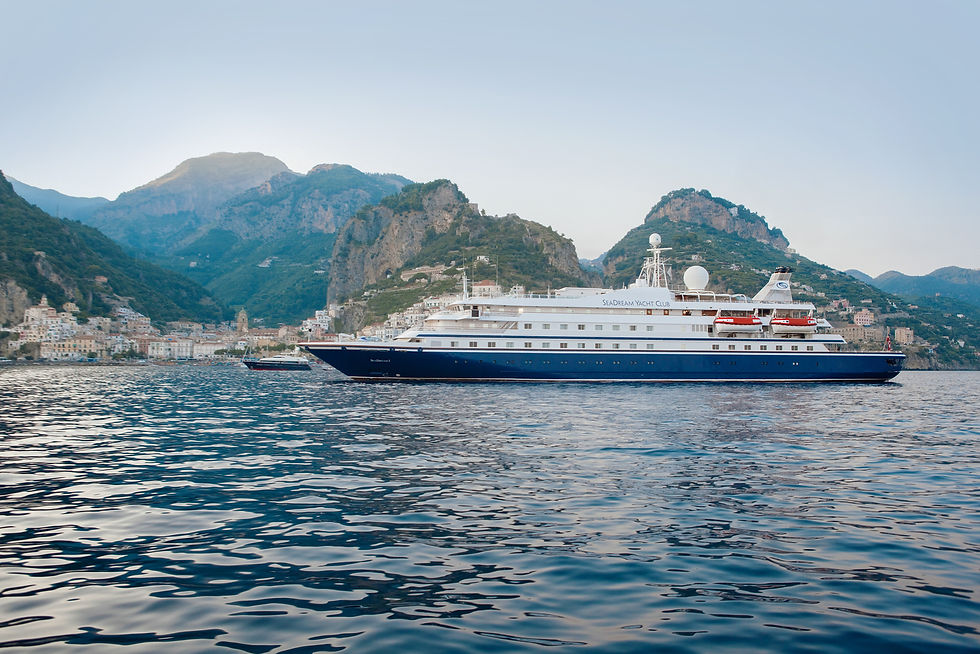
SeaDream Yacht Club: For the True Yachting Traveler
SeaDream is the outlier in this group, and that is exactly why it belongs here.
Its vessels are genuinely small by modern cruise standards, creating an experience much closer to yachting than conventional cruising. That scale allows SeaDream to build Mediterranean itineraries around smaller ports, long days ashore, late departures, and occasional overnights. Its 2026 program, for example, includes calls and overnights in places such as Capri, Hvar, Cassis, and Amalfi, along with Corinth Canal transits on selected voyages.
On board, the emphasis is on outdoor living, informal elegance, personalized service, and enjoying the sea itself. Watersports can operate directly from the yacht when conditions and local permissions allow.
The tradeoff is straightforward: you are not getting the physical variety of a larger luxury vessel. There are fewer restaurants and public spaces, and accommodations will not resemble the expansive suite inventory found on some newer ships.
For the right traveler, none of that matters.
Best suited to: Travelers who value intimacy, outdoor living, small harbors, a casual atmosphere, and the feeling of traveling aboard a yacht more than having an extensive resort around them.
Think twice if: A large private terrace, elaborate spa, numerous restaurants, substantial evening entertainment, or a wide choice of onboard venues is important to your vacation.

The Ritz-Carlton Yacht Collection: For the Luxury-Hotel Traveler at Sea
The Ritz-Carlton Yacht Collection occupies another interesting position for travelers who do not naturally identify as cruisers. Its three yachts vary in size. Evrima has 149 suites, while Ilma and Luminara have 224 and 226 respectively. Every suite has a private terrace. The onboard approach combines multiple restaurants, resort-style public spaces, a marina platform, and the service vocabulary associated with Ritz-Carlton hotels.
The standard experience is broadly inclusive: accommodations, most dining, premium beverages, gratuities, Wi-Fi, and marina watersports are included. A small number of specialty dining experiences carry an additional charge, an example of why “all-inclusive” always deserves a closer look.
There is also a practical distinction for Marriott Bonvoy travelers: The Ritz-Carlton Yacht Collection participates in Marriott Bonvoy, allowing eligible members to earn and redeem points and receive applicable recognition.
Best suited to: Luxury-hotel travelers who want an easy bridge into cruising, particularly those who value private terraces, contemporary accommodations, familiar service standards, and a relaxed resort-like environment.
Think twice if: Your primary goal is the smallest and most informal yacht experience possible, or you prefer the traditions and rhythms of an established luxury cruise line.
Why the Itinerary May Matter More Than the Cruise Line
Once you have identified two or three cruise lines that suit you, stop comparing brands for a moment. Compare the itineraries. This is especially important in the Mediterranean, where a beautiful list of destinations can disguise considerable travel drag.
A cruise itinerary might say “Florence,” for example, but the ship does not sail up the Arno and dock beside the Duomo. Florence generally means arriving at a coastal port and traveling inland. Rome presents the same issue. The distance between ship and destination consumes part of your day.
At other ports, you can step ashore and immediately be where you want to be.
Ship size matters here as well. Smaller vessels can sometimes use ports or anchorages unavailable to larger ships. SeaDream's Mediterranean schedules illustrate the advantage particularly well, with calls at places such as Ponza, Bonifacio, Saint-Florent, and other smaller coastal destinations. Seabourn likewise deliberately incorporates boutique ports and yacht harbors into its Mediterranean program.
When we evaluate an itinerary, the questions extend beyond the names printed in the brochure:
How long is the ship actually in port? Is there an overnight or late departure? Where does the vessel dock or anchor? How long does it take to reach the place you actually want to see? Will five other large ships be arriving at roughly the same time? And does the schedule allow enough time for a thoughtful private experience ashore rather than a hurried circuit of highlights?
A famous port is not necessarily a good port day.
Western Mediterranean, Adriatic, or Greek Isles?
“Mediterranean cruise” describes an enormous geographic area, and choosing the right region can be as important as choosing the ship.
Western Mediterranean
Voyages incorporating Spain, southern France, Monaco, and western Italy work particularly well for travelers interested in food, art, shopping, wine, and sophisticated coastal destinations.
The logistical downside is that some marquee cultural destinations sit well inland from the cruise port. The itinerary therefore deserves careful examination, particularly if Rome or Florence is a priority.
The Adriatic
Croatia and Montenegro can be especially rewarding from the water. Dubrovnik, Hvar, Korčula, Rovinj, Kotor, and the surrounding coastline naturally lend themselves to a smaller-ship itinerary.
The Adriatic can be an excellent choice for travelers who want a balance of historic towns, swimming, beautiful coastlines, and comparatively manageable distances.
Greece and the Aegean
A Greek Isles itinerary can shift the emphasis toward island life, archaeological sites, long lunches, swimming, and the pleasure of moving between dramatically different islands.
But “Greek Isles” is not one uniform experience. Mykonos and Santorini create a very different trip from an itinerary emphasizing smaller islands and less-trafficked ports. Here again, the port list matters more than the label on the itinerary.
When Is the Best Time for a Mediterranean Cruise?
For many Vantage Voyages travelers, the most appealing Mediterranean cruise periods are late spring and early fall rather than the height of summer.
May and June can provide warm weather, long days, and a lively atmosphere before the most intense heat and crowds arrive. September can be particularly attractive because the sea has had an entire summer to warm, while some destinations begin to settle into a more comfortable rhythm.
July and August still make sense for families constrained by school calendars and for travelers who actively want the Mediterranean at its most energetic. But they also bring heat and substantial visitor volume to many of the region's most popular ports.
October can be excellent for sightseeing and food-focused travel, although travelers prioritizing swimming, beach clubs, and reliably hot weather may prefer earlier dates.
There is no universally “best” Mediterranean month. The right timing depends on whether you are optimizing for swimming, sightseeing, nightlife, family schedules, weather, or fewer crowds.
What Does “All-Inclusive” Actually Mean on a Luxury Cruise?
This is one of the easiest areas to misunderstand.
Two cruise lines can both use the term “all-inclusive” while including materially different things.
Regent currently incorporates unlimited shore excursions into its standard offering. Silversea's current Classic-voyage fare structure gives travelers different fare choices, and shore arrangements depend on the fare selected. The Ritz-Carlton Yacht Collection includes most dining but charges separately for certain specialty venues. Other lines may include beverages, Wi-Fi, and gratuities while treating shore experiences separately.
The practical comparison therefore is not: Which cruise costs less?
It is: What will this trip cost when configured the way you actually want to travel?
If you want private touring in every port, we should price that into the comparison. If you value included excursions, that matters. If you drink very little but care deeply about suite size, the weighting changes again.
The headline fare is only the beginning of the analysis.
The Vantage Perspective: Start With the Traveler, Not the Cruise Line
We do not believe there is one best luxury cruise line in the Mediterranean.
There is a best fit for a particular traveler, on a particular itinerary, at a particular time.
For one client, that might mean SeaDream because waking at anchor outside a small Mediterranean harbor matters more than having six restaurants to choose from. For another, Explora's contemporary design and resort-like public spaces may make the ship itself an essential part of the vacation. Regent may be the natural choice for someone who wants as much as possible handled in advance, while Silversea or Seabourn may provide exactly the balance of destination, service, and established luxury-cruise culture another traveler prefers. Ritz-Carlton Yacht Collection can make particular sense for someone whose reference point is the luxury-hotel world rather than cruising.
And sometimes the right answer changes because of one itinerary.
That is why cruise planning should go deeper than choosing a brand. We look at the ship, the specific suite, where it is located, the ports, arrival and departure times, touring opportunities, seasonal conditions, and the hotels and logistics before and after the voyage.
The cruise is only one component of the journey.
A beautifully designed Mediterranean trip might begin with three nights at a favorite hotel in Rome, continue aboard a ship through the Adriatic, and finish with several quiet days on the Croatian coast. Or the cruise itself may be the centerpiece, with the pre- and post-voyage arrangements deliberately kept simple.
The strategy depends on you.
So, Which Luxury Mediterranean Cruise Should You Choose?
If you remember only one thing, make it this:
Do not choose your Mediterranean cruise by asking which cruise line is best. Choose it by asking which experience most closely resembles the way you already know you like to travel.
Do you prefer a yacht or a resort? A full schedule or room for spontaneity? Private touring or included excursions? Small harbors or marquee destinations? Contemporary design or established cruising traditions? A ship you cannot wait to explore, or one that quietly carries you to the next destination?
Once those questions are answered, the field becomes much smaller. And that is where thoughtful cruise planning creates value. The goal is not to put you on the smallest ship, the newest ship, or the cruise line at the top of somebody else's ranking.
It is to put you on the right voyage.
Planning a Mediterranean cruise? Vantage Voyages can compare itineraries, ships, suite categories, shore experiences, and pre- and post-cruise arrangements to help you find the voyage that fits the way you actually want to travel. Speak with Vantage Voyages about your plans.